
In industrial refrigeration systems, one of the most critical and effective components is the evaporator. The evaporator is essentially the part of the refrigeration cycle that absorbs heat from the environment or product and transfers it, via the refrigerant, to other components such as the compressor and condenser. In this article, we introduce the various types of evaporators and their applications in different cold storages — particularly in below-freezing and above-freezing storage rooms.
The Role of the Evaporator in Cold Storage Systems
The evaporator is where the refrigerant, after passing through the liquid line and the expansion valve, enters and evaporates by absorbing heat from the internal space of the cold room. This evaporation lowers the room temperature and completes the cooling process. Evaporators come in various designs, each suited for specific conditions such as operating temperature, product type, humidity level, and type of cold storage.
General Classification of Evaporators
Evaporators can be classified according to several criteria:
Air movement
Forced-air or natural convection
Mounting type
Wall-mounted, ceiling-mounted, or floor-mounted
Coil and fin structure
Coil type, plate type, finned type, etc
Application
Freezing or storage
Below, we review the most common evaporator types and their applications.
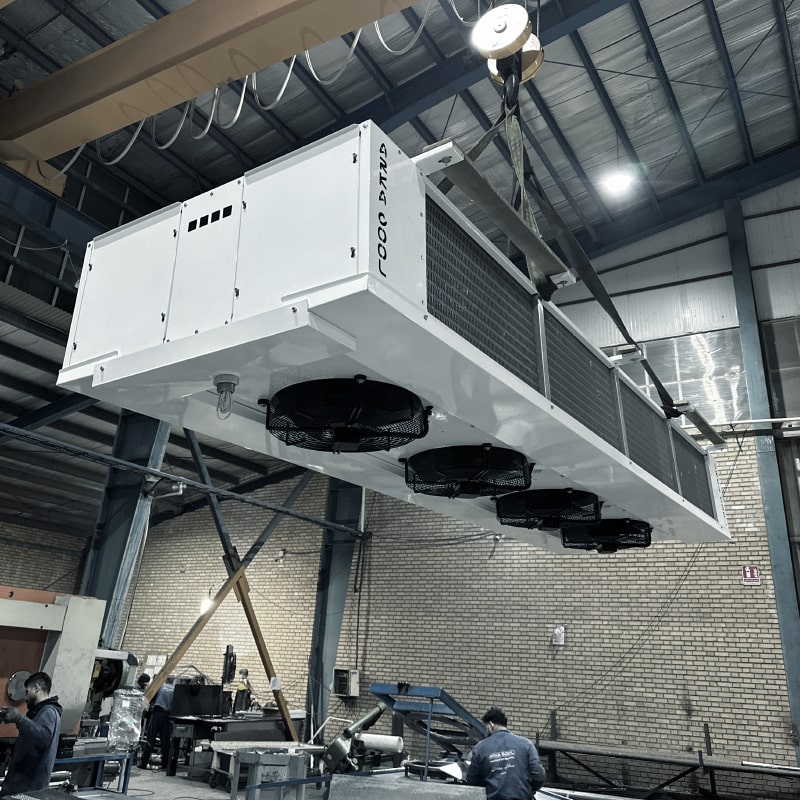
1. Forced-Air Evaporator
This type features fans that force air through the cold coils at high speed, ensuring uniform temperature distribution in the cold room. Commonly used in:
Below-freezing cold storages
Freezing tunnels
- Large-volume above-freezing cold rooms
Advantages
Uniform cooling
High cooling efficiency
- Suitable for perishable goods like meat and fish
Note: For effective performance, the compressor and condenser must be properly sized to match the capacity of this type of evaporator.
2. Plate Evaporator
Typically used in small cold rooms or commercial display refrigerators. Large metal plates provide a high contact surface area for rapid heat transfer.
Above-freezing cold rooms with limited space
Storing dairy or vegetables
Advantages
Compact design
No fans required
Lower energy consumption
3. Coil Evaporator
The most common type in industrial cold storages, made of copper or aluminum tubes with aluminum fins. Widely used in:
Large below-freezing cold rooms
Above-freezing cold rooms
Food processing halls
Advantages
High cooling capacity
Compatible with different refrigerants
Suitable for both humid and dry environments
4. Floor-Mounted Block Evaporator
Used in specific applications with high cooling loads. Typically installed in large storage halls.
Cold storages with high heat loads
Food processing lines
Note: Requires a powerful condenser and high-capacity liquid line for proper operation.
Selecting the Evaporator Based on Cold Storage Type
The type of cold storage directly affects evaporator selection:
In below-freezing cold storages: higher capacity, lower evaporation temperature, and anti-icing features are needed. Stronger fans and wider fin spacing are recommended to prevent frost buildup.
In above-freezing cold storages: quieter evaporators with gentle airflow are preferred to maintain the quality of fruits, vegetables, and pharmaceuticals.
Design Parameters of an Evaporator
No evaporator operates in isolation; its performance must match the specifications of the compressor, type of condenser, liquid line design, and even the expansion valve. For example, if a high-capacity evaporator is installed but the compressor is undersized, the system will quickly suffer from pressure drop and low efficiency. Similarly, improper refrigerant flow adjustment may result in under- or overfeeding of the evaporator.
Evaporator Interaction with Other Refrigeration Components
No evaporator operates in isolation; its performance must match the specifications of the compressor, type of condenser, liquid line design, and even the expansion valve. For example, if a high-capacity evaporator is installed but the compressor is undersized, the system will quickly suffer from pressure drop and low efficiency. Similarly, improper refrigerant flow adjustment may result in under- or overfeeding of the evaporator.
Modern Technologies in Evaporators
Today, new designs include technologies such as antibacterial coated fins, hydrophobic fins to reduce ice adhesion, inverter fans with variable speed control, and smart humidity and temperature sensors. These technologies not only improve energy efficiency but also reduce maintenance costs and extend system life.
The Importance of Proper Design for Energy Efficiency and Performance
Choosing and properly designing the evaporator not only ensures optimal cooling but also plays a significant role in optimizing energy consumption. For instance, using high-fin evaporators improves heat transfer efficiency, allowing the compressor to operate at lower pressures. Additionally, smart controllers can adjust the system based on varying load conditions, reducing compressor cycling and extending its lifespan.
Selecting the Evaporator Based on Stored Product
The type of product stored in the cold room directly impacts evaporator selection. For example, meat products require low temperatures and high airflow, making powerful forced-air evaporators ideal. In contrast, sensitive products such as flowers, medicines, or certain fruits should be kept in environments with gentle and steady airflow. In such cases, quiet, low-speed fan evaporators are more suitable.
Maintenance and Servicing of Evaporators
Regular maintenance of the evaporator — including coil cleaning, fan performance checks, defrost control, and refrigerant leak inspection — not only extends the device’s service life but also reduces electricity consumption. These inspections should be performed by experienced technicians at least every six months.
Conclusion
Proper selection of the evaporator plays a key role in the efficiency of the cold storage. Full coordination with other system components, including compressor, condenser, and liquid line, is essential. Additionally, the type of cold storage (below-freezing or above-freezing), type of product, required capacity, and physical installation space all influence the final selection.
Consulting with Arkacool
If you need guidance in selecting the right evaporator for your cold storage, our technical experts at Arkacool are ready to assist you in the design, supply, and installation of cooling equipment.


No comment